Types of Embroidery Machines and their Functions
Embroidery has been an important part of textile and apparel decoration for centuries. With the development of modern technology, traditional hand embroidery has evolved into highly efficient and precise machine embroidery. Today, an embroidery machine is an essential piece of equipment for garment manufacturers, textile factories, fashion brands, uniform suppliers, promotional product businesses, embroidery service providers, and custom apparel businesses.
A modern embroidery machine can automatically create complex patterns, logos, lettering, decorative motifs, patches, monograms, and other designs on different types of fabrics. Compared with manual embroidery, computerized embroidery machines provide greater speed, accuracy, consistency, repeatability, and production efficiency.
For businesses involved in garment manufacturing or textile production, choosing the right embroidery machine can directly affect production capacity, product quality, labor requirements, operational efficiency, and overall profitability.
In this comprehensive guide, we will explore what an embroidery machine is, how an embroidery machine works, different types of embroidery machines, industrial embroidery machines, computerized embroidery machines, single-head and multi-head embroidery machines, important machine features, embroidery applications, benefits, maintenance requirements, and how to choose the right embroidery machine for your business.
What Is an Embroidery Machine?
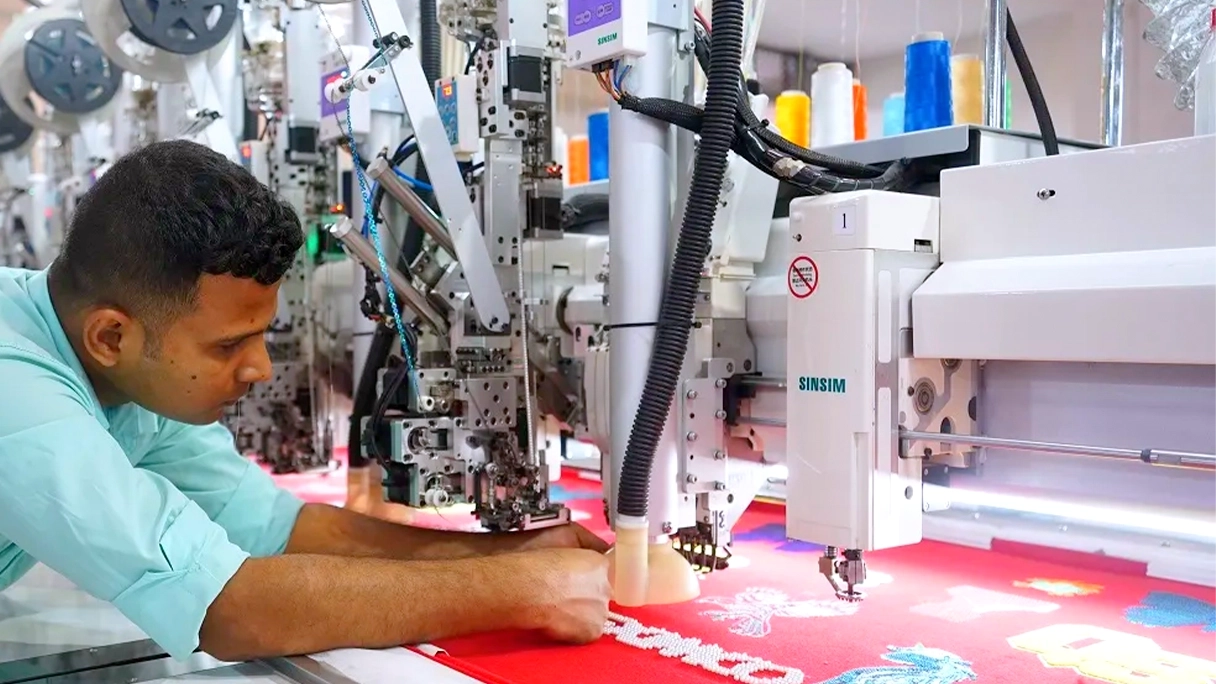
An embroidery machine is a specialized machine designed to automatically create decorative stitches, patterns, lettering, logos, and other designs on fabric and textile materials.
Unlike traditional hand embroidery, where an operator manually creates each stitch, a modern computerized embroidery machine follows a digital embroidery design file. The machine controls the movement of the embroidery frame, needles, threads, and other mechanisms according to programmed instructions.
Modern embroidery machines are widely used for:
An advanced industrial embroidery machine can operate for extended production periods while maintaining consistent embroidery quality across large production orders.
How Does an Embroidery Machine Work?
Understanding how an embroidery machine works is important before investing in embroidery equipment.
Modern computerized embroidery generally follows a digital workflow. First, a design is created or converted into an embroidery-compatible digital file. The design is then loaded into the machine. The fabric is secured using an embroidery hoop or frame, and the machine follows the programmed stitch instructions.
The basic process includes:
1. Creating the Design
The embroidery process begins with artwork, text, logos, patterns, or graphics.
A designer can create artwork using graphic design software and then convert it into an embroidery design using specialized digitizing software.
2. Embroidery Digitizing
Digitizing converts artwork into stitch instructions that the embroidery machine can understand.
The digitized file can contain information such as:
-
Stitch type
-
Stitch density
-
Stitch direction
-
Stitch length
-
Color sequence
-
Needle sequence
-
Underlay
-
Thread changes
-
Trim commands
-
Jump stitches
-
Design positioning
Proper digitizing is extremely important because even a high-quality embroidery machine cannot produce an excellent result from a poorly digitized design.
3. Preparing the Fabric
The fabric is placed inside an embroidery hoop or frame.
Depending on the fabric and design, stabilizers may be used to prevent distortion, puckering, stretching, or movement during embroidery.
4. Loading the Embroidery Design
The digital embroidery file is transferred to the machine through the machine's supported interface or storage system.
The operator selects the design and checks important settings before starting production.
5. Thread Setup
The required embroidery threads are installed on the machine.
Multi-needle embroidery machines can keep multiple thread colors ready at the same time. This reduces the need for frequent manual thread changes.
6. Automatic Embroidery
Once the machine starts, the embroidery head and frame move according to the programmed design.
The machine creates the design stitch by stitch.
7. Thread and Color Management
Modern computerized embroidery machines can automatically perform many operations, including needle selection, color changes, thread trimming, and machine stopping when certain errors occur.
8. Final Inspection
After embroidery is completed, the finished product is checked for:
-
Stitch quality
-
Thread tension
-
Design alignment
-
Thread breaks
-
Puckering
-
Missing stitches
-
Color accuracy
-
Overall appearance
This workflow allows businesses to produce repeatable and professional embroidery at significantly higher efficiency than manual embroidery.
Types of Embroidery Machines
There are several types of embroidery machines available for different applications, production volumes, fabrics, and business requirements.
Understanding the differences between embroidery machine types helps buyers choose equipment according to their actual production needs.
The major categories include:
-
Single-needle embroidery machines
Let's examine each type in detail.
1. Single-Needle Embroidery Machine
A single-needle embroidery machine uses one needle at a time to create embroidery designs.
These machines are generally suitable for smaller embroidery jobs, personal projects, beginners, hobby users, and businesses with relatively low production requirements.
A single-needle embroidery machine may require manual thread changes when a design contains multiple colors.
Common applications
-
Small custom embroidery
-
Personalized garments
-
Monogramming
-
Hobby embroidery
-
Small business embroidery
-
Custom gifts
-
Small logo work
Advantages
-
Simple operation
-
Compact design
-
Suitable for beginners
-
Lower initial investment
-
Useful for small embroidery jobs
Limitations
For high-volume commercial production, a single-needle machine may require more operator intervention because different thread colors need to be changed manually.
2. Multi-Needle Embroidery Machine
A multi-needle embroidery machine is designed with multiple needles, allowing several thread colors to be installed simultaneously.
This makes multi-needle embroidery machines particularly useful for professional embroidery businesses.
Instead of stopping the machine every time a color needs to be changed, the machine can automatically select the required needle.
Benefits of a multi-needle embroidery machine
-
Faster color changes
-
Reduced operator intervention
-
Better production efficiency
-
Suitable for complex designs
-
Multiple thread colors available
-
Professional embroidery workflow
-
Improved productivity
For businesses producing logos, uniforms, promotional garments, caps, jackets, and customized clothing, a multi-needle embroidery machine can significantly improve workflow efficiency.
3. Single-Head Embroidery Machine
A single-head embroidery machine has one embroidery head.
It is commonly used by embroidery businesses that require professional production capability but do not yet need a large multi-head production line.
Single-head embroidery machines are suitable for:
-
Small and medium businesses
-
Custom embroidery
-
Sampling
-
Small garment orders
-
Logo embroidery
-
Cap embroidery
-
Uniform embroidery
-
Fashion embroidery
-
Promotional products
A single-head industrial embroidery machine can also be an effective solution for businesses that want to start commercial embroidery production and gradually expand.
4. Multi-Head Embroidery Machine
A multi-head embroidery machine contains multiple embroidery heads. Each head can generally embroider the same design on separate garments simultaneously.
This makes multi-head machines particularly valuable for large-scale production.
For example, instead of embroidering one shirt at a time, a multi-head embroidery machine can process several garments simultaneously depending on its configuration.
Applications of multi-head embroidery machines
Multi-head embroidery machines are commonly used for:
-
Large garment production
-
Export garment factories
-
Uniform manufacturing
-
Corporate apparel
-
Sportswear
-
Promotional clothing
-
Workwear
-
Fashion production
-
Large embroidery orders
Why choose a multi-head embroidery machine?
The biggest advantage is production efficiency.
When production volume is high, a multi-head embroidery machine can help businesses produce more embroidered products within a shorter production cycle.
5. Computerized Embroidery Machine
A computerized embroidery machine uses digital technology to control embroidery operations.
Instead of manually guiding every stitch, the machine receives a digital embroidery file and automatically executes the programmed design.
Modern computerized embroidery machines can control:
-
Needle movement
-
Stitch patterns
-
Thread colors
-
Stitch density
-
Design positioning
-
Thread trimming
-
Color changes
-
Embroidery speed
-
Machine stopping functions
Computerized embroidery technology has transformed the textile industry by allowing businesses to produce highly detailed designs with consistent quality.
6. Industrial Embroidery Machine
An industrial embroidery machine is designed for professional and high-volume embroidery production.
Industrial embroidery machines are generally built for durability, continuous operation, high productivity, and consistent embroidery quality.
They are widely used in:
-
Garment factories
-
Textile manufacturing
-
Export-oriented apparel production
-
Uniform factories
-
Fashion manufacturing
-
Sportswear production
-
Home textile production
-
Commercial embroidery businesses
An industrial embroidery machine may feature multiple needles, multiple heads, automatic color changes, automatic thread trimming, large memory capacity, advanced control systems, and specialized embroidery functions.
For businesses handling regular production orders, an industrial embroidery machine can be a long-term production asset.
7. Commercial Embroidery Machine
A commercial embroidery machine is designed for businesses that provide embroidery services or produce embroidered products for customers.
Commercial embroidery machines sit between small-scale embroidery equipment and large industrial production systems, depending on their configuration.
Typical commercial applications include:
-
Custom clothing
-
Corporate branding
-
Promotional products
-
Uniform embroidery
-
Cap embroidery
-
Personalized gifts
-
Sports team apparel
-
Fashion products
-
Small-batch manufacturing
The right commercial embroidery machine depends on order volume, required embroidery field, number of colors, production speed, product type, and available workspace.
8. Flat Embroidery Machine
A flat embroidery machine is designed primarily for embroidering flat textile surfaces.
Common products include:
-
T-shirts
-
Shirts
-
Fabrics
-
Towels
-
Flat garments
-
Textile panels
-
Home textile products
Flat embroidery is widely used in garment and textile manufacturing.
9. Cap Embroidery Machine
Caps and hats have a curved structure, which means they require specialized framing and embroidery techniques.
A machine with a suitable cap embroidery system allows businesses to embroider logos and designs on:
-
Baseball caps
-
Sports caps
-
Promotional caps
-
Corporate caps
-
Fashion hats
-
Uniform headwear
Cap embroidery is particularly popular for branding and promotional products.
10. Sequin Embroidery Machine
A sequin embroidery machine is designed to attach decorative sequins during embroidery.
Sequin embroidery is widely used in fashion and decorative textile applications.
Common products include:
-
Fashion garments
-
Party dresses
-
Bridal wear
-
Stage costumes
-
Decorative fabrics
-
Designer garments
-
Traditional clothing
Modern embroidery production may combine traditional stitching with decorative elements such as sequins for enhanced visual effects.
11. Chenille Embroidery Machine
Chenille embroidery creates a raised, textured embroidery effect.
It is particularly popular for:
-
Varsity jackets
-
School apparel
-
Sportswear
-
Fashion garments
-
Badges
-
Patches
-
Decorative textile products
Chenille embroidery provides a distinctive three-dimensional appearance compared with standard embroidery.
12. Schiffli Embroidery Machine
A Schiffli embroidery machine is a specialized large-scale embroidery system historically associated with high-volume textile embroidery.
Schiffli machines can be used for large embroidered textile panels and intricate decorative patterns.
They are particularly relevant to specialized textile manufacturing where large-scale embroidery production is required.
Embroidery Machine Applications
An embroidery machine can be used across many industries and product categories.
Garment Industry
The garment industry is one of the largest users of industrial embroidery machines.
Embroidery is used for:
-
Brand logos
-
Decorative patterns
-
Product branding
-
Garment embellishment
-
Labels
-
Patches
-
Fashion designs
Corporate Uniforms
Businesses use embroidery machines to add company logos and employee names to:
-
Shirts
-
Polo shirts
-
Jackets
-
Workwear
-
Security uniforms
-
Corporate uniforms
Embroidered logos generally provide a professional and durable branding solution.
School Uniforms
Schools, colleges, and educational institutions can use embroidery for:
-
School logos
-
Student names
-
Institutional branding
-
Badges
Sportswear
Embroidery machines are commonly used for:
-
Team logos
-
Player names
-
Sports club branding
-
Caps
-
Jackets
-
Training wear
Fashion Industry
Fashion designers use embroidery machines to create:
-
Decorative motifs
-
Floral patterns
-
Premium embellishments
-
Logo designs
-
Monograms
-
Custom fashion elements
Home Textiles
Embroidery machines can also be used for:
-
Towels
-
Bed linens
-
Cushion covers
-
Curtains
-
Blankets
-
Decorative fabrics
-
Home décor products
Promotional Products
Businesses can use embroidery for promotional merchandise such as:
-
Caps
-
Bags
-
Polo shirts
-
Jackets
-
Corporate gifts
-
Branded uniforms
Why Is an Embroidery Machine Important for Modern Textile Production?
The textile industry is highly competitive, and manufacturers need to produce products quickly while maintaining consistent quality.
An embroidery machine provides several important advantages.
1. High Production Efficiency
Automated embroidery can produce designs significantly faster than manual embroidery.
This allows businesses to handle larger production orders.
2. Consistent Quality
A computerized embroidery machine follows programmed instructions, helping maintain consistency across repeated designs.
3. Reduced Manual Work
Automation reduces the amount of repetitive manual work required from operators.
4. Complex Design Capability
Modern embroidery machines can reproduce detailed digital designs that may be difficult or time-consuming to produce manually.
5. Better Branding
Embroidered logos provide businesses with a professional way to display their brand identity on apparel and promotional products.
6. Scalable Production
Businesses can choose between single-head and multi-head embroidery machines depending on their production requirements.
7. Product Customization
Embroidery machines allow businesses to offer personalized products, including names, logos, numbers, monograms, and custom designs.
Important Features to Consider When Buying an Embroidery Machine
Choosing the right embroidery machine requires more than simply looking at the machine price.
Buyers should evaluate several technical and production factors.
Number of Needles
Needle count determines how many thread colors can remain installed and ready for use.
For multicolor designs, a higher needle count can reduce manual color changes.
Number of Heads
The number of embroidery heads affects production capacity.
Single-head machines are suitable for smaller production requirements, while multi-head embroidery machines are designed for higher-volume production.
Embroidery Speed
Machine speed is often measured in stitches per minute, commonly abbreviated as SPM.
However, maximum speed should not be the only consideration. Actual productivity also depends on:
-
Design complexity
-
Stitch density
-
Thread changes
-
Trimming
-
Fabric type
-
Operator efficiency
-
Machine setup
Embroidery Field Size
The embroidery field determines the maximum area that can be embroidered in a single setup.
Businesses producing jacket backs, large logos, banners, or larger decorative designs should carefully evaluate field size.
Automatic Thread Trimming
Automatic thread trimming can reduce manual work and improve production efficiency.
Automatic Color Change
Automatic needle selection and color change can reduce production interruptions.
Touchscreen Control
Modern computerized embroidery machines often use touchscreen control panels to simplify machine operation and design management.
Memory Capacity
Memory capacity determines how many embroidery designs and stitch data can be stored.
Businesses with large design libraries should consider sufficient memory capacity.
Frame and Hoop Options
Different products require different hoop sizes and framing systems.
Before purchasing an embroidery machine, consider whether it supports the products you plan to manufacture.
Cap Embroidery Capability
If your business produces caps or hats, ensure the machine supports appropriate cap frames and cap embroidery applications.
Technical Support
After-sales service is an important consideration when purchasing industrial embroidery machinery.
Technical support, spare parts availability, operator training, maintenance support, and troubleshooting assistance can significantly affect long-term machine performance.
How to Choose the Right Embroidery Machine for Your Business
The best embroidery machine depends on your business rather than simply its specifications.
Before making a purchase, consider the following questions.
What products will you embroider?
Will you produce:
-
T-shirts?
-
Polo shirts?
-
Caps?
-
Jackets?
-
Uniforms?
-
Bags?
-
Towels?
-
Fashion garments?
-
Home textiles?
Your products will determine the appropriate machine configuration.
How much production do you need?
A small custom embroidery business may need a single-head embroidery machine.
A growing commercial embroidery business may benefit from a multi-needle or single-head industrial embroidery machine.
A large garment factory may require a multi-head industrial embroidery machine for higher production capacity.
How many colors do your designs use?
If your designs commonly contain many colors, a multi-needle embroidery machine can reduce manual thread-changing requirements.
What is your available workspace?
Industrial embroidery machines can require significant floor space, especially multi-head configurations.
Consider:
-
Machine dimensions
-
Operator area
-
Material storage
-
Thread storage
-
Maintenance access
-
Electrical requirements
What level of technical support do you need?
For industrial production, machine support is an important part of the investment decision.
Embroidery Machine for Garment Factories
Garment factories often require embroidery machines capable of handling continuous production.
An industrial embroidery machine for garment manufacturing should be evaluated based on:
-
Production volume
-
Number of heads
-
Needle configuration
-
Embroidery field
-
Fabric compatibility
-
Machine speed
-
Automation
-
Thread management
-
Maintenance requirements
-
Spare parts availability
-
Technical support
For export-oriented garment production, reliability and production consistency are particularly important.
Embroidery Machine for Small Businesses
Small embroidery businesses have different requirements from large factories.
A small business may focus on:
-
Custom T-shirts
-
Polo shirts
-
Caps
-
School uniforms
-
Corporate uniforms
-
Personalized gifts
-
Small batch production
For such businesses, a compact commercial or single-head multi-needle embroidery machine may provide an effective balance between flexibility, production capacity, and investment.
Embroidery Machine for Branding and Logo Embroidery
Logo embroidery is one of the most common commercial applications of embroidery machines.
Companies can embroider their logos on:
-
Employee uniforms
-
Polo shirts
-
Jackets
-
Caps
-
Bags
-
Workwear
-
Promotional products
Because logos need to remain consistent across many garments, computerized embroidery machines are particularly useful for commercial branding applications.
Embroidery Machine Maintenance
Regular maintenance is essential for keeping an embroidery machine operating efficiently.
Important maintenance activities may include:
-
Cleaning the machine
-
Removing lint
-
Checking thread paths
-
Cleaning the bobbin area
-
Checking needle condition
-
Replacing damaged needles
-
Checking thread tension
-
Lubricating components according to manufacturer instructions
-
Inspecting moving parts
-
Checking sensors
-
Maintaining embroidery frames
-
Following recommended service schedules
Poor maintenance can result in:
-
Thread breaks
-
Skipped stitches
-
Poor embroidery quality
-
Needle breaks
-
Machine downtime
-
Increased production costs
Regular preventive maintenance can help extend machine life and maintain consistent embroidery quality.
Common Embroidery Machine Problems
Even modern embroidery machines can experience operational issues.
Common problems include:
Thread Breaking
Possible causes include incorrect tension, damaged needles, poor-quality thread, incorrect threading, or unsuitable machine settings.
Skipped Stitches
Skipped stitches can occur because of needle problems, incorrect settings, fabric movement, or mechanical issues.
Thread Nesting
Thread nesting can occur when upper thread tension, bobbin tension, threading, or machine timing is incorrect.
Fabric Puckering
Puckering can be caused by unsuitable stabilizer selection, excessive stitch density, incorrect tension, or poor hooping.
Needle Breaking
Needle breakage can result from incorrect needle size, improper hooping, design problems, or mechanical issues.
Correct machine setup, suitable materials, proper digitizing, and regular maintenance are essential for reducing these problems.
Embroidery Digitizing and Embroidery Machine Performance
An important point for anyone purchasing an embroidery machine is that machine quality alone does not determine the final result.
Embroidery digitizing plays a major role.
A professional digitized design should consider:
-
Fabric type
-
Stitch density
-
Underlay
-
Stitch direction
-
Pull compensation
-
Thread sequence
-
Color sequence
-
Design size
-
Stitch length
A poorly digitized design can create problems even when using an advanced industrial embroidery machine.
Therefore, successful embroidery production requires a combination of:
Quality Embroidery Machine + Professional Digitizing + Correct Thread + Suitable Needle + Proper Stabilizer + Skilled Operation + Regular Maintenance
Embroidery Machine vs Manual Embroidery
Manual embroidery depends heavily on human skill and requires significant time for detailed designs.
An embroidery machine automates many parts of the process.
Manual Embroidery
-
High labor requirement
-
Slower production
-
Highly dependent on individual skill
-
Difficult to reproduce exactly at large scale
-
Suitable for artistic and handcrafted work
Machine Embroidery
-
Faster production
-
Digital design control
-
Repeatable results
-
Suitable for commercial production
-
Better for large orders
-
Consistent branding
-
Easier scalability
For commercial textile production, machine embroidery provides significant advantages in productivity and repeatability.
How Much Does an Embroidery Machine Cost?
The embroidery machine price depends on several factors.
There is no single price applicable to every embroidery machine because machines differ significantly in configuration and capability.
Factors affecting embroidery machine price include:
-
Number of needles
-
Number of embroidery heads
-
Embroidery field size
-
Machine speed
-
Automation level
-
Brand
-
Build quality
-
Software compatibility
-
Special embroidery functions
-
Accessories
-
Technical support
-
Spare parts availability
A small single-head machine and a large multi-head industrial embroidery machine can have very different investment requirements.
For businesses, it is therefore better to compare the total production value, machine capability, expected workload, maintenance requirements, and after-sales support rather than selecting a machine based only on initial price.
Embroidery Machine in Bangladesh
Bangladesh has a large and growing textile and garment manufacturing industry. As garment manufacturers, uniform producers, fashion businesses, and textile companies increasingly focus on value-added products, demand for professional embroidery solutions continues to be important.
An embroidery machine in Bangladesh can be used across:
-
Garment factories
-
Textile factories
-
Export garment manufacturers
-
Uniform manufacturers
-
Fashion houses
-
Promotional product businesses
-
Embroidery service centers
-
Small and medium businesses
For buyers in Bangladesh, machine selection should consider not only technical specifications but also local technical support, spare parts availability, operator training, installation, maintenance, and long-term service.
Why Choose an Industrial Embroidery Machine?
For businesses handling regular production, an industrial embroidery machine can offer several advantages.
High Productivity
Designed for professional production environments.
Better Automation
Automated needle selection, thread trimming, color changes, and machine controls can reduce manual intervention.
Consistent Results
Digital control allows repeated designs to be produced consistently.
Production Scalability
Businesses can increase capacity by choosing configurations with more embroidery heads.
Professional Finish
Industrial embroidery equipment can produce clean and durable embroidery when correctly configured and operated.
Future of Embroidery Machine Technology
The embroidery industry continues to evolve with improvements in automation, computerized controls, machine precision, production monitoring, and digital design workflows.
Future embroidery machine technology is expected to focus increasingly on:
-
Automation
-
Smart machine controls
-
Digital production management
-
Improved energy efficiency
-
Faster setup
-
Better error detection
-
Advanced thread management
-
Improved embroidery precision
-
Digital connectivity
-
Production monitoring
-
More efficient workflows
As textile manufacturers continue adopting advanced production technology, modern computerized embroidery machines are becoming an increasingly important part of value-added garment production.
Frequently Asked Questions About Embroidery Machines
What is an embroidery machine?
An embroidery machine is a specialized machine that automatically creates decorative stitches, patterns, logos, lettering, and designs on fabric using programmed embroidery instructions.
What is the difference between a sewing machine and an embroidery machine?
A sewing machine is primarily designed for joining fabric and creating seams, while an embroidery machine is designed to create decorative stitched designs. Some combination machines can perform both sewing and embroidery functions.
What is a computerized embroidery machine?
A computerized embroidery machine uses digital embroidery files to automatically control stitching, design positioning, needle selection, thread colors, and other embroidery operations.
What is an industrial embroidery machine?
An industrial embroidery machine is designed for professional, commercial, and high-volume embroidery production. It typically offers higher production capability, automation, durability, and specialized features compared with basic home machines.
What is a multi-head embroidery machine?
A multi-head embroidery machine has multiple embroidery heads and can generally embroider the same design on multiple products simultaneously, making it suitable for higher-volume production.
What is a multi-needle embroidery machine?
A multi-needle embroidery machine has multiple needles, allowing several thread colors to remain loaded at the same time. This makes automatic color changes possible and reduces manual intervention.
Which embroidery machine is best for a business?
The best embroidery machine depends on production volume, product type, design complexity, required colors, available space, budget, and future growth plans.
Is an embroidery machine good for a garment business?
Yes. Embroidery machines are widely used in garment businesses for logos, uniforms, fashion designs, sportswear, caps, jackets, and customized apparel.
Can an embroidery machine embroider caps?
Yes. Machines equipped with suitable cap frames and cap embroidery capabilities can embroider designs on caps and other headwear.
Can an embroidery machine embroider logos?
Yes. Logo embroidery is one of the most common applications of computerized and commercial embroidery machines.
Is an industrial embroidery machine suitable for small businesses?
It can be, particularly when a business expects regular production or plans to scale. However, the machine configuration should match actual production requirements.
How do I choose an embroidery machine?
Consider the number of needles, number of heads, embroidery field, machine speed, product types, automation features, technical support, maintenance requirements, and expected production volume before purchasing.
How important is embroidery digitizing?
Embroidery digitizing is extremely important because it converts artwork into stitch instructions. Proper digitizing helps the embroidery machine produce cleaner, more accurate, and more consistent results.
Final Thoughts
An embroidery machine is much more than a machine for decorating fabric. It is an important production tool for modern garment manufacturing, textile businesses, fashion brands, uniform suppliers, promotional product companies, and professional embroidery businesses.
From single-head and multi-needle embroidery machines to large multi-head industrial embroidery systems, different machines are designed for different production requirements.
The right embroidery machine can help businesses improve production efficiency, maintain consistent embroidery quality, reduce repetitive manual work, create complex designs, offer customization, and expand their product range.
However, selecting an embroidery machine should always be based on actual business requirements. Production volume, product type, embroidery field, needle configuration, automation, technical support, maintenance, and long-term scalability should all be considered before making an investment.
For businesses planning to enter or expand the embroidery industry, understanding the different types of embroidery machines, their functions, applications, technical features, and production capabilities is the first step toward making a smarter machinery investment.
Whether you are looking for an industrial embroidery machine, computerized embroidery machine, commercial embroidery machine, single-head embroidery machine, multi-head embroidery machine, or multi-needle embroidery machine, choosing the right equipment can make a significant difference in productivity, quality, and long-term business growth.
Looking for the Right Embroidery Machine for Your Business?
Whether you are planning to start a new embroidery business, upgrade your existing production line, or looking for a high-performance industrial embroidery machine, SINSIM Bangladesh is here to help.
From Flat Embroidery Machines, Cap & Tubular Embroidery Machines, Multi-Head Embroidery Machines, Sequin Embroidery Machines, Beads Embroidery Machines, Chenille Embroidery Machines, Tufting Embroidery Machines, Laser Cutting Embroidery Machines and other specialized embroidery solutions, SINSIM offers advanced technology designed for modern garment and textile production.
With global technology, genuine SINSIM parts, professional sales support, operator training, and lifetime after-sales service in Bangladesh, we help factories achieve better production efficiency, consistent embroidery quality, and long-term performance.
Get Expert Assistance for Your Embroidery Machine
📞 Call / WhatsApp: 01997-353535 | 01997-343434
📧 Email: info@sinsimbd.com
🌐 Website: sinsimbd.com
📍 Corporate Office: Suite B2, Level 03, Plot 32, Road 01 (Jasimuddin Avenue), Sector 03, Uttara, Dhaka-1230, Bangladesh.
SINSIM — Advanced Embroidery Technology for Modern Textile Production.